
ICMICA Pax Romana Special Regional Session on
Reimagining the Role of Catholic Lay in Africa
Mt 9:17
Don Bosco Gotera. Aet Vice – Province Catholic Church,
Chirkos 04, Addis Ababa (Ethiopia),
Official Communiqué
2nd May 2026
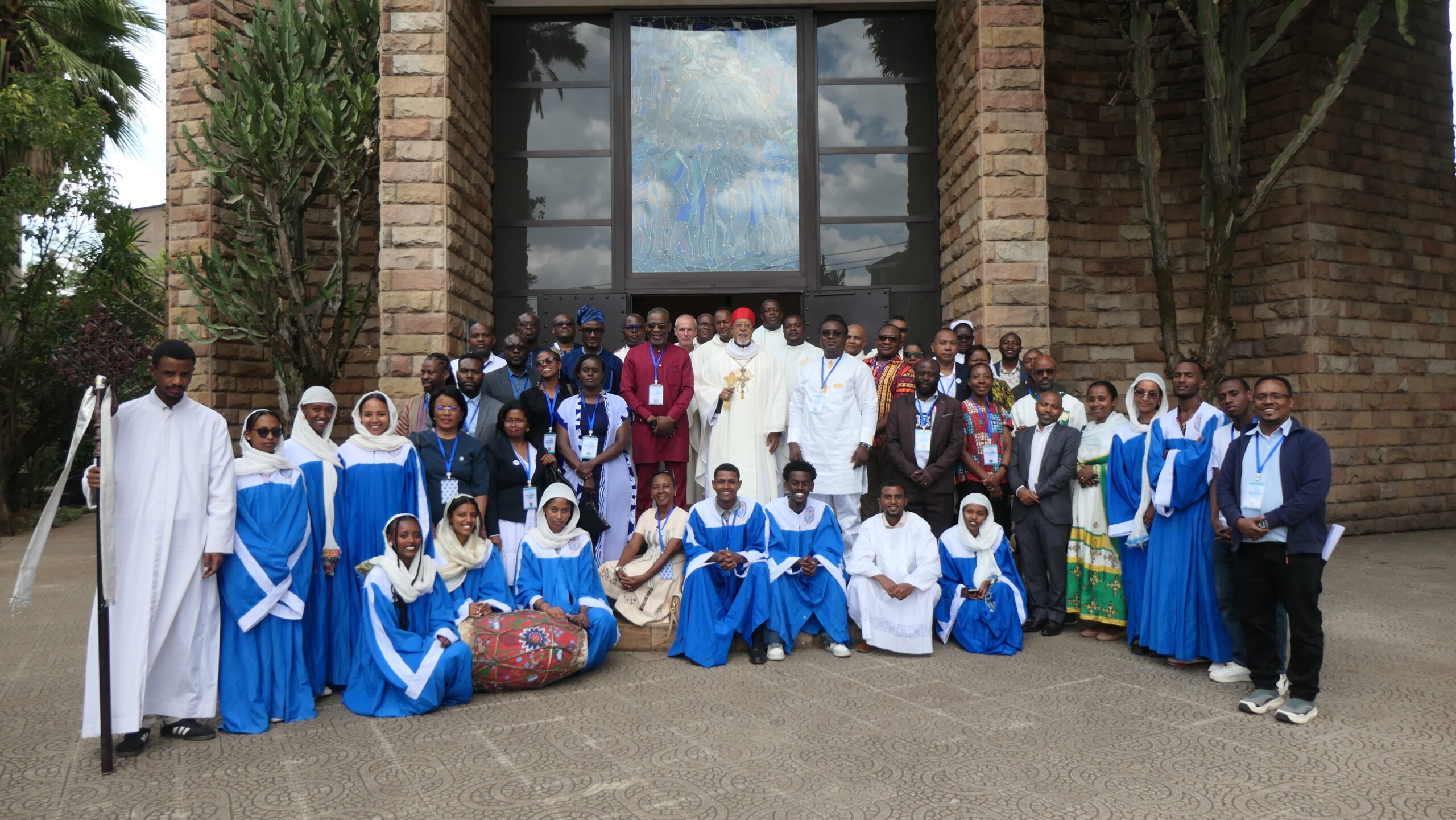
We, Catholic Intellectuals and Professionals from across Africa, under the auspices of Pax Romana-ICMICA Africa, met from 1-2 May 2026, in Addis Ababa (Ethiopia) at Don Bosco Centre to reflect on the theme “Reimagining the Role of Catholic Lay in Africa’’. In the spirit of Africae Munus, we are hopeful that our collective efforts and commitment will make us realize the Africa we want. We commit to continue strengthening our cooperation with the church and nurturing our church identity. We express deep gratitude to the Church in Ethiopia, and particularly to Cardinal Berhanyesus D. Suraphel, Metropolitan Archbishop of Addis Ababa, for his support, guidance, and inspiration. We express deep appreciation to Archbishop Brian Udaigwe, Apostolic Nuncio to Ethiopia, for his precious care.
A. Reflecting on Our Identity as Catholic Lay Professionals:
We recognize that, as members of Pax Romana ICMICA, we are a unique category of people, with special gifts of professional formation, responsibility to work towards the African society we want, leveraging our numerical strength and presence in all spheres of life.[i] In line with Pope Francis’s Apostolic Exhortation, Evangelii Gaudium and the ongoing Synodality process in the Church, we appreciate that ‘the mission of the Church is a mission of all’, rooted in co-responsibility, faith, and shared values. We recognize that through this mission, we are invited to promote the participation of the laity in the life of the Church, in the spirit of Vatican II.
We re-commit to play an important role in the social, economic, and political transformation of our societies, a role that starts with personal conversion, in line with John Paul II’s Post-Synodal Apostolic Exhortation Christifideles Laici. More so, we identify ourselves with a spirituality that integrates faith and action for coherence between Church Teaching (Catholic Social Teachings, etc.). We commit to retracing our footsteps to the key Catholic Social Teachings on the preferential option for the poor.
B. Reflecting on the Challenges facing our Continent, Africa:
We note that Africa is making social, economic, and political progress amid numerous challenges, including governance deficits, civil and political upheavals, conflicts, climate change, rising poverty, endemic corruption, and troubling insecurity. A growing number of African countries are classified as fragile states, unable to provide basic public services, maintain security, or uphold the rule of law for the people. Africa accounts for more than 70% of the world’s population living in severe poverty.[ii] On the other hand, Africa’s population is believed to be the youngest in the world, with 60% of the continent’s population aged under 25. This demographic opportunity unarguably positions Africa at the center of the global economy, with its youth population likely to shape future global consumption, culture, stability, and resilience.
C. Reflecting on Africa’s most pressing issue of youth:
We acknowledge that the state of joblessness and unemployment in Africa is affecting mostly young people. Each year, close to 11 million African youth enter the labor market, yet only 3 million formal sector jobs are created, pushing the majority of them into the insecure informal sector (with very low income and no social protection). Others are forced to seek economic opportunities outside Africa under strenuous conditions. For some of these young graduates, the level of formal training does not adequately prepare them to face the dynamic world of work. They simply do not have the right skills, competence, and attitude required by the labor market and are victims of skills mismatch. We are concerned that the formal education systems are also not adequately imparting the required morals and soft skills for youth to navigate life and be useful members of their communities.
We note that this issue touches Pax Romana ICMICA Africa since the unemployed youth constitute young graduates who are also Catholics, and are former members of student movements like YCS, IYCW, IMCS, etc.
We commit not to stand on the periphery but to accompany the youth as they transition from the world of training to the world of work. We further commit to work closely with other stakeholders, including governments, training institutions, the Church (parishes and dioceses, catholic schools and universities, etc.), and those in the industry.
D. Reflecting on Our Relationship with the Church and Society:
We recognize that our identity requires us to continue to engage more actively in public issues to promote societal well-being, justice, peace, and diversity. We have a responsibility to contribute towards the common good by engaging in dialogue and collaboration with other stakeholders.[iii]
We resolve to strengthen our partnership with these stakeholders, recognizing that we shall increase our visibility, especially within Church structures and beyond. To this end, we endeavor to scale up our engagement with national, sub‑regional, and regional episcopal conferences.[iv] We implore our members to participate and deploy their professional skills in the life of the Church, right from the Small Christian Communities (SCCs) level, as part of their commitment to the Church’s mission and the renewal of the parish community. These communities serve as a model of Church life, emphasizing the importance of communion, participation, mission, and the sharing of faith experiences.
We also commit to consolidating our special consultative status within the United Nations – an extraordinary asset that remains significantly underutilized. This status offers us a unique platform to influence global discourse, contribute to policy debates, and amplify the concerns of African communities within international spaces. We agree that to justify and sustain this privilege, we need to demonstrate clear value in the engagement. We resolve to expand our special consultative status to more regional and international agencies, including the African Union.
E. Reflecting on the Concept of Multilateralism and the Care of Our Common Home:
We reflected on the concept of multilateralismin the context of the world today, which is in turmoil. We are concerned that our continent still grapples with the aftermath of colonialism, economic dependency, and political instability. We are further concerned that, as the world faces a new era of global disorder, our continent is being pushed to the periphery of multilateralism and isseriously affected by the increasing lack of a dignifying and people-centred global consensus in the international system. We feel that the current international financial architecture is unfair and imposes constraints on African countries, especially access to the necessary finance for socioeconomic development. In this regard, fiscal space reforms, development financing, and debt management must be addressed explicitly and urgently as human rights issues for the emergence of a strong human rights economy that allows fiscal equity, protects human dignity, enables a people-centered, inclusive development that works for all, and particularly the most vulnerable.
We reflected on the beauty of our continent, especially the natural environment. We also reflected on the biblical charge to be stewards and guides of our common home (Genesis 2:15). As Catholic Professionals, we reaffirm our commitment to the call to care for our common home (Laudato Si)[v]. To challenge ecological injustice, promote integral ecology, and bring consciousness to this divine charge from God.
F. Reflecting on Our Internal Challenges as Pax Romana:
We reflected on the life of the movement in Africa and acknowledged that Pax Romana ICMICA needs to expand its presence on the continent. In some countries, the transition from one leadership to another remains a challenge. Efforts to attract the youth and young graduates to the movement must continue. Efforts to foster regional collaborations must be reenergized.
We recognize that Pax Romana ICMICA previously relied on financial and non-financial support from partners, but the financial dependence model is not working. Regular contributions from members, currently very low, should be encouraged and boosted. We commit to developing innovative financing mechanisms, such as investments in financial markets, among others, that are aligned with the values and principles of the Church.
We recognize that the formation of lay Catholics in Africa, including equipping them with relevant training and skills to fulfill their roles within the Church and society, remains both a key challenge and opportunity. We promise a structured formation program for lay people, enhance our lay apostolate engagement to continue translating the Gospel into a tangible spiritual and social transformation tool.
We believe in the Church and its leadership to guide our vision and inspire our actions to build a strong, faith-based, resilient Africa.
Addis Ababa, May 2, 2026.
Dr. Jules Zannou
International Vice President for Africa
Pax Romana ICMICA
[i] Statistics show that one in five Catholics in the world is African with African Catholic professionals hold positions in governments, judiciaries, corporations, and international institutions
[ii] World Bank Report , 2026
[iii] Including the Church, International Organizations, Non-governmental organizations, Civil Society Organizations, the private sector
[iv] Including The Association of Member Episcopal Conferences in Eastern Africa (AMECEA), CERNA, Regional Episcopal Conference of West Africa (RECOWA), Inter-regional Meeting of Bishops of Southern Africa (IMBISA), and the Symposium of Episcopal Conferences of Africa and Madagascar (SECAM).
[v] Laudato Si